Net Loan Proceeds: The Money That Actually Reaches You
A $10,000 loan with a fee taken out of it deposits less than $10,000, yet you repay all of it with interest. Here is how to find the deposit on your disclosure, and how to size the loan when you need an exact sum.
Fees and add-ons, by LendCedar Editorial Team Updated 7 minute read
In short
Net proceeds are the part of a loan you actually receive. When an origination fee is deducted from the loan, the lender keeps it at funding and deposits the rest, but your payments are figured on the full loan amount. When the fee is added on top, the loan grows instead and the deposit stays whole. Either way the Truth in Lending disclosure shows what you get as the amount financed. If you need a set sum, divide it by one minus the fee rate and round up.
- On the disclosure
- Amount financed
- $10,000 with 5% taken out
- $9,500 deposited
- To net $10,000 at 5%
- Borrow about $10,527
- Itemization
- Yours on request
What net proceeds are
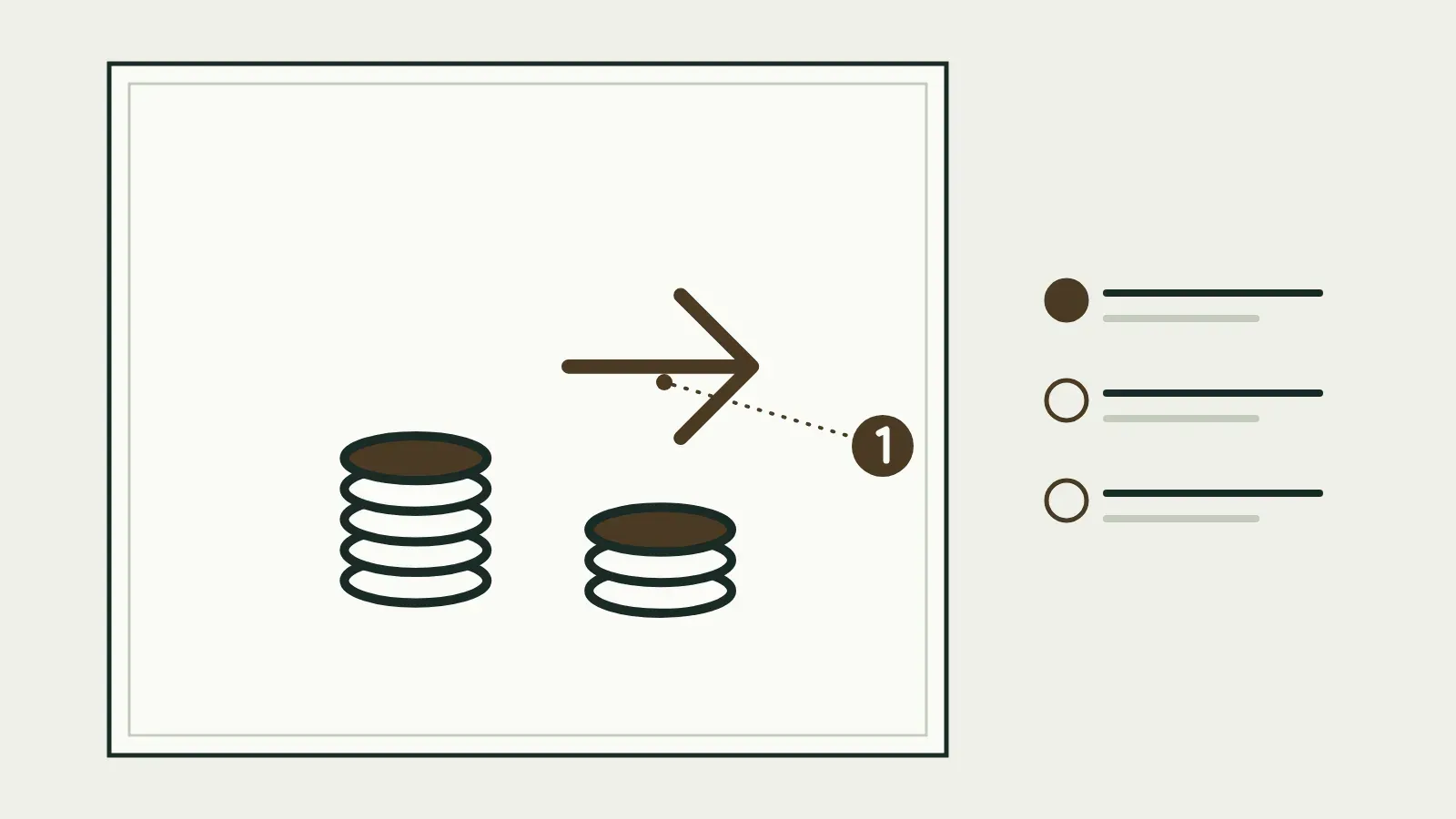
The loan amount in an offer is the sum you agree to repay with interest. The net proceeds are the money that lands in your account or goes out to pay your other bills. The two match only when nothing is taken out before funding. An origination fee, sometimes called a processing or administrative fee, is the charge that most often opens a gap between them.
Regulation Z, the rule under the Truth in Lending Act, has a precise name for the credit you really get: the amount financed. The lender works it out by starting with the loan amount, adding any other financed sums that are not part of the finance charge, and subtracting any prepaid finance charge. A fee withheld at funding is a prepaid finance charge, so it is subtracted, and the amount financed comes out lower than the face of the loan.
Loan amount
The principal on the note. Your monthly payment and the interest are calculated on this figure.
Prepaid finance charge
A fee you pay at or before funding, whether in cash or out of the loan itself. An origination fee is the usual example.
Amount financed
The loan amount minus the prepaid finance charge. It is the credit you actually receive, and the base the APR is measured against.
Deducted or added on top: two ways to charge a fee
A lender can collect the same fee in two ways, and the offer may not say which until you read the disclosure. Here is a 5% fee on a $10,000 need at 14% for 36 months, both ways. The figures are worked examples computed with the amortization formula, not offers from any lender.
| Line of the offer | Fee deducted | Fee added on top |
|---|---|---|
| Loan amount on the note | $10,000 | $10,500 |
| Amount financed (your deposit) | $9,500 | $10,000 |
| Monthly payment | $341.78 | $358.87 |
| Total of payments | $12,304.08 | $12,919.32 |
| Finance charge | $2,804.08 | $2,919.32 |
| APR | 17.65% | 17.47% |
With the fee deducted, you repay $12,304.08 for $9,500 in hand. With the fee added on top, you get the full $10,000 but owe $10,500 and pay interest on the fee itself for three years. The APR is close in both cases because it already counts the fee as a cost of the credit; the deposit is what differs.
How to borrow enough to net the sum you need
If a fee will be taken out and you need a fixed amount, such as a $10,000 repair invoice, ask for a bigger loan. The method is called grossing up.
- Write down the sum you need to receive, for example $10,000.
- Convert the fee to a decimal and subtract it from 1. A 5% fee gives 1 − 0.05 = 0.95.
- Divide the sum by that number: $10,000 ÷ 0.95 = $10,526.32.
- Round up to the lender's loan increment, here $10,527. The fee is $526.35 and the deposit is $10,000.65.
- Check the new payment. At 14% for 36 months it is $359.79, with a total of payments of $12,952.44 and an APR of 17.65%.
A flat fee works differently: add it to the sum you need instead of dividing. If the lender's fee has a minimum or a maximum, gross up and then check the fee the lender actually quotes on the larger loan. The net proceeds calculator runs both cases and shows the payment on the grossed-up loan.
Borrowing more costs more, so first ask whether you can pay the fee from savings or choose an offer with no fee. Grossing up keeps the deposit whole; it does not make the fee cheaper.
Other things that can lower the deposit
A fee is not the only reason a deposit runs short. Regulation Z requires the lender either to give you a written breakdown of the amount financed, called an itemization, or to tell you that you have the right to one, with a space to ask for it. The itemization shows where each dollar goes.
- Money sent to other creditors. On a consolidation loan the lender may pay your card or loan balances directly, and only the remainder reaches you.
- Payoff of an earlier loan with the same lender, when you refinance or take a new loan to replace an old one.
- Add-on products financed into the loan, such as optional credit insurance. These raise the amount you owe; see credit insurance and add-ons.
Ask for the itemization before you sign and check each line. A payee you do not recognize, or a charge you did not agree to, is a reason to stop and ask.
Questions to ask before you sign
- Is there an origination fee, and is it a percentage or a flat amount?
- Will the fee be taken out of the loan, added to it, or paid by me at closing?
- What is the amount financed, and may I have the written itemization?
- If I pay the loan off early, is any part of the fee refunded?
The answers belong on the Truth in Lending disclosure, which the lender must give you before you are bound. To see how the fee changes the full price of the loan, read total cost of a loan. Some states limit what a licensed lender may charge up front; check your state's rules.
Sources
- Regulation Z, 12 CFR 1026.18 — Content of disclosures: amount financed and its itemization (CFPB)
- Regulation Z, 12 CFR 1026.4 — Finance charge (CFPB)
- What is a personal installment loan? (Consumer Financial Protection Bureau)
- Regulation Z, 12 CFR 1026.22 — Determination of annual percentage rate (CFPB)
- Federal Reserve G.19 Consumer Credit release, October 7, 2026
We checked the facts on this page against these sources on October 27, 2026. All loan figures are worked examples, not offers; their APRs use the actuarial method and assume every payment is made on schedule.
Questions people ask
Do I pay interest on the origination fee if it is deducted?
In effect, yes. Your payments are calculated on the full loan amount, including the part the lender kept as a fee. That is why the APR on a loan with a deducted fee is higher than its interest rate.
Where do I find my net proceeds on the loan papers?
Look for the amount financed in the Truth in Lending box. If money is sent to other creditors on your behalf, the itemization of the amount financed shows how much goes to each payee and how much is paid to you directly.
Is a loan with no origination fee always cheaper?
No. A loan with no fee can carry a higher interest rate. Compare APRs between offers of the same length, then check the finance charge; the offer comparison calculator lines them up.
Should I just borrow extra to cover the fee?
Only if you cannot pay the fee another way and you need the exact sum. A larger loan means a larger payment and more interest, so first compare offers without a fee and the cost of paying the fee from savings.
Ask lenders for real offers
Describe the loan you have in mind. LendCedar passes your request to lenders and loan brokers who may contact you with offers; you compare them and decide.
- The loan you have in mind: amount, purpose, credit and income.
- Your contact details and your consent to be contacted.
- A lender or loan broker may contact you with an offer. Nothing is decided until you sign with a lender.
LendCedar is not a lender or a loan broker and does not make credit decisions.
You pay LendCedar nothing. Lenders and loan brokers pay us for requests, and they set their own rates and terms. How we make money.
Nearby in the guide
-
Offer term
Total cost of a loan
Finance charge, APR and total of payments, with three worked offers for the same $10,000 loan.
-
Step
Signing and funding
What to check before you sign, e-signing consent, how the money arrives, and why most loans have no cooling-off period.
-
Loan use
Tax bills
IRS payment plan fees, penalty and interest compared with a personal loan on an $8,000 tax bill.