Personal Loans in Washington: What Licensed Lenders May Charge
Washington's Consumer Loan Act caps interest at 25% a year for licensed lenders, and a 2024 law reaches companies that use a bank's charter to charge more. Here is how the limit works, who needs a license, and where to check a lender.
Cap 36% or less, by LendCedar Editorial Team Updated 6 minute read
In short
A company that makes consumer loans in Washington needs a consumer loan license from the Department of Financial Institutions (DFI) under the Consumer Loan Act, chapter 31.04 RCW. Under RCW 31.04.105 it may charge simple interest of up to 25% a year plus an origination fee of up to 4% of the first $20,000 and 2% of the rest. Since June 6, 2024, a company can be treated as the lender, and held to these rules, even if it says it only works for a bank. All in, that allows about 29% APR on a $2,000 two-year loan and about 27% on a $10,000 five-year loan.
- $2,000 loan cap
- 29% APR
- $10,000 loan cap
- 27% APR
- Interest limit
- 25% simple interest
- Licensed by
- DFI
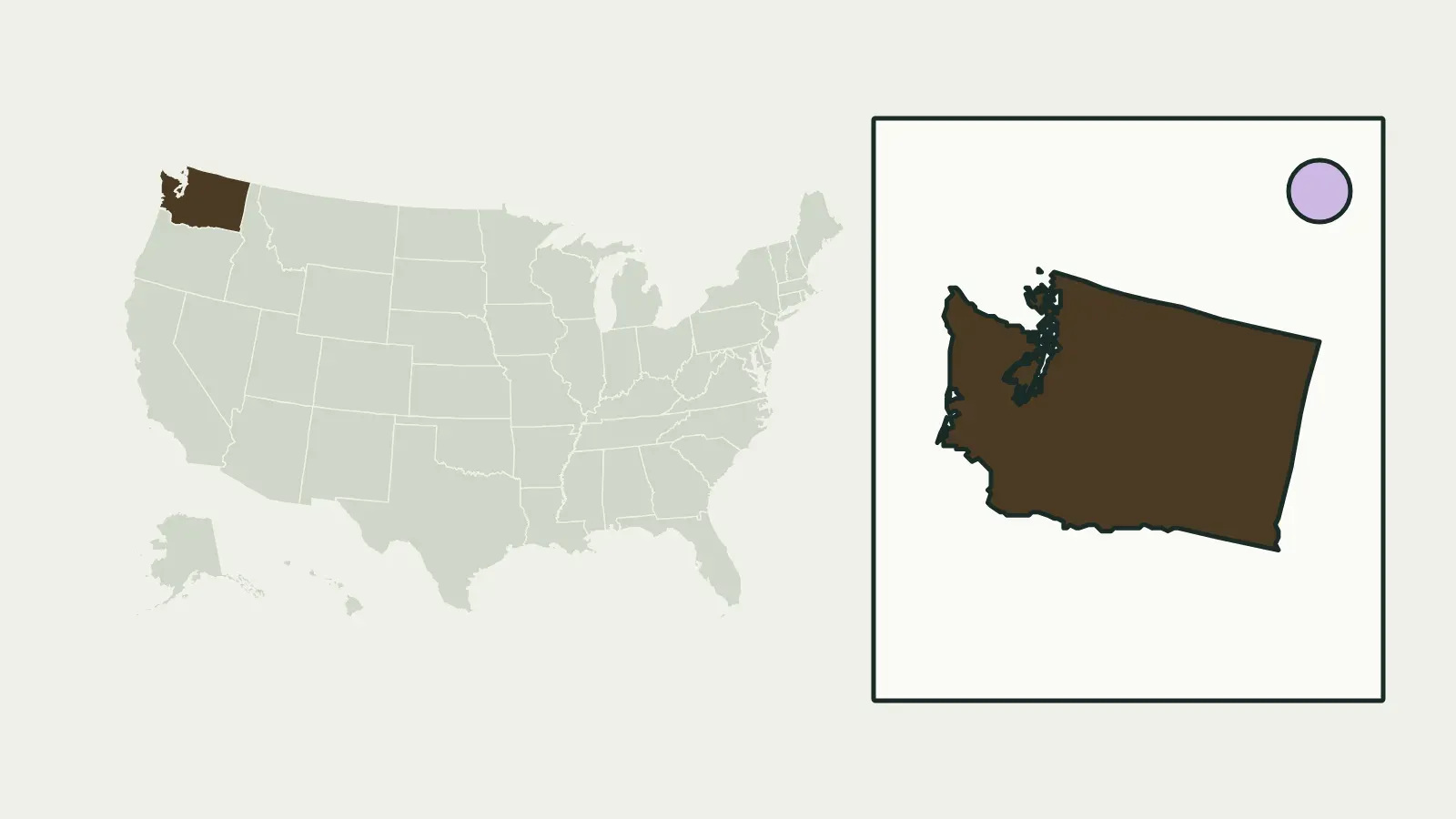
Washington at a glance
How the Washington rate limit works
RCW 31.04.105 sets one flat rate for every loan size, computed by the simple interest method, plus a limited set of charges. The origination fee is prepaid and nonrefundable, and it may be added to the loan balance.
| Charge | Limit |
|---|---|
| Interest | 25% a year, simple interest |
| Origination fee, first $20,000 | Up to 4% of principal |
| Origination fee, above $20,000 | Up to 2% of principal |
| Late charge | Up to 10% of an installment 10 or more days late |
Here is how the pieces combine. Borrow $2,000 for 24 months at 25% with an $80 origination fee added to the balance: the payment is $111.01, you repay $2,664.24 in all, and the APR on your Truth in Lending disclosure comes to about 29.2%. These figures are an example, not an offer.
The 2024 Predatory Loan Prevention Act
In 2024 Washington amended the scope section of the Consumer Loan Act, RCW 31.04.025, through an act titled the "predatory loan prevention act." It applies to loans made on or after June 6, 2024, and to older loans renegotiated or modified after that date.
- Predominant economic interest: a company that claims to act as an agent or service provider for an exempt party, such as a bank, is treated as the lender if the loan's rate is higher than Washington allows and the company holds, acquires or keeps the predominant economic interest in the loan.
- Totality of the circumstances: the company is also treated as the lender if the circumstances show it is the lender and the deal is structured to evade the chapter.
- No subterfuge: the act bars any device, subterfuge or pretense to evade the chapter, including arranging a loan at a higher rate.
The burden of proving an exemption is on the company that claims it. The practical effect: a nonbank company that holds the predominant economic interest in a bank-partner loan to a Washington resident can be held to the Consumer Loan Act, including its 25% limit.
Who needs a license and who does not
RCW 31.04.035 says no one may engage in any activity covered by the chapter without first getting and keeping a license. The chapter covers loans made to Washington residents or people physically in the state. A consumer loan made without a required license is void and unenforceable.
- Banks, savings banks, trust companies and credit unions doing business under the laws that govern them are exempt, and a bank may charge the rates its home state allows.
- Business, commercial and agricultural loans are exempt unless they are secured by the borrower's primary home.
- Payday and auto title loans are a separate subject. Our sister site Lendmira covers them on its Washington lending laws page.
On the NCLC comparison of a $2,000 two-year loan, Oregon allows about 36% APR, while Idaho has no numeric cap and relies on an unconscionability standard. The state rules map shows every state side by side.
Check a lender and file a complaint
- Look up the license on the DFI's verify a license page or in NMLS Consumer Access before you apply.
- Check the APR on the disclosure. If a nonbank offer is well above about 29% on a small loan, ask under what authority the company lends to Washington residents.
- Keep the loan papers: the Truth in Lending disclosure, the agreement and any messages about fees.
- Complain to the DFI on its complaint page or by phone at 1-877-746-4334, Monday to Friday, 8 a.m. to 5 p.m. Pacific.
- Send a complaint to the CFPB as well if the lender is a bank or a bank partner, or if you are unsure who regulates it.
If a lender asks for a fee before it will approve or fund the loan, treat it as a warning sign; how to verify a lender explains what to check.
Sources
- RCW 31.04.105 — Authorized actions by licensees (Washington State Legislature)
- RCW 31.04.025 — Application of chapter, anti-evasion and exemptions (Washington State Legislature)
- RCW 31.04.035 — License required (Washington State Legislature)
- Washington State Department of Financial Institutions — complaints and license verification
- State APR caps for $500, $2,000 and $10,000 installment loans, December 2025 (National Consumer Law Center)
We checked the facts on this page against these sources on October 27, 2026. The 2024 anti-evasion provisions apply to loans made on or after June 6, 2024.
Questions people ask
What is the maximum interest rate on a personal loan in Washington?
A lender licensed under the Consumer Loan Act may charge simple interest of up to 25% a year, plus an origination fee of up to 4% of the first $20,000 of principal and 2% of the rest.
Can an online lender get around Washington's limit by partnering with a bank?
Less easily since June 6, 2024. Under RCW 31.04.025, a company that holds the predominant economic interest in a loan, or that is the lender under the totality of the circumstances, is treated as the lender even if a bank's name is on the agreement.
What late fee can a Washington consumer lender charge?
Up to 10% of an installment payment that is 10 or more days late, under RCW 31.04.105.
How do I know if a Washington lender is licensed?
Use the DFI license verification page or NMLS Consumer Access. A consumer loan made without a required license is void and unenforceable. See how to verify a lender.
Ask lenders for real offers
Describe the loan you have in mind. LendCedar passes your request to lenders and loan brokers who may contact you with offers; you compare them and decide.
- The loan you have in mind: amount, purpose, credit and income.
- Your contact details and your consent to be contacted.
- A lender or loan broker may contact you with an offer. Nothing is decided until you sign with a lender.
LendCedar is not a lender or a loan broker and does not make credit decisions.
You pay LendCedar nothing. Lenders and loan brokers pay us for requests, and they set their own rates and terms. How we make money.
Nearby in the guide
-
Offer term
Total cost of a loan
Finance charge, APR and total of payments, with three worked offers for the same $10,000 loan.
-
Step
Verify a lender
Find the license on NMLS or with your state, match the lender of record and spot advance-fee scams.
-
Step
Where to borrow
Banks, credit unions, online lenders, CDFIs and finance companies: who regulates each and what they may charge.