Personal Loans in Pennsylvania: What Licensed Lenders May Charge
Pennsylvania keeps finance-company loans among the lowest-priced in the country. Here is how the Consumer Discount Company Act works, who needs a license and where to check a lender.
Cap 36% or less, by LendCedar Editorial Team Updated 5 minute read
In short
In Pennsylvania, a finance company that makes non-mortgage consumer loans is licensed as a consumer discount company under the Consumer Discount Company Act of 1937 by the Department of Banking and Securities (DoBS). The act sets the most such a company may charge. The National Consumer Law Center, which compares state caps, puts that ceiling at about 24% APR on a $2,000 two-year loan and about 26% on a $10,000 five-year loan, fees included, among the lowest limits of any state.
- $2,000 loan cap
- 24% APR
- $10,000 loan cap
- 26% APR
- Lender law
- Consumer Discount Co. Act
- Licensed by
- Pa. DoBS
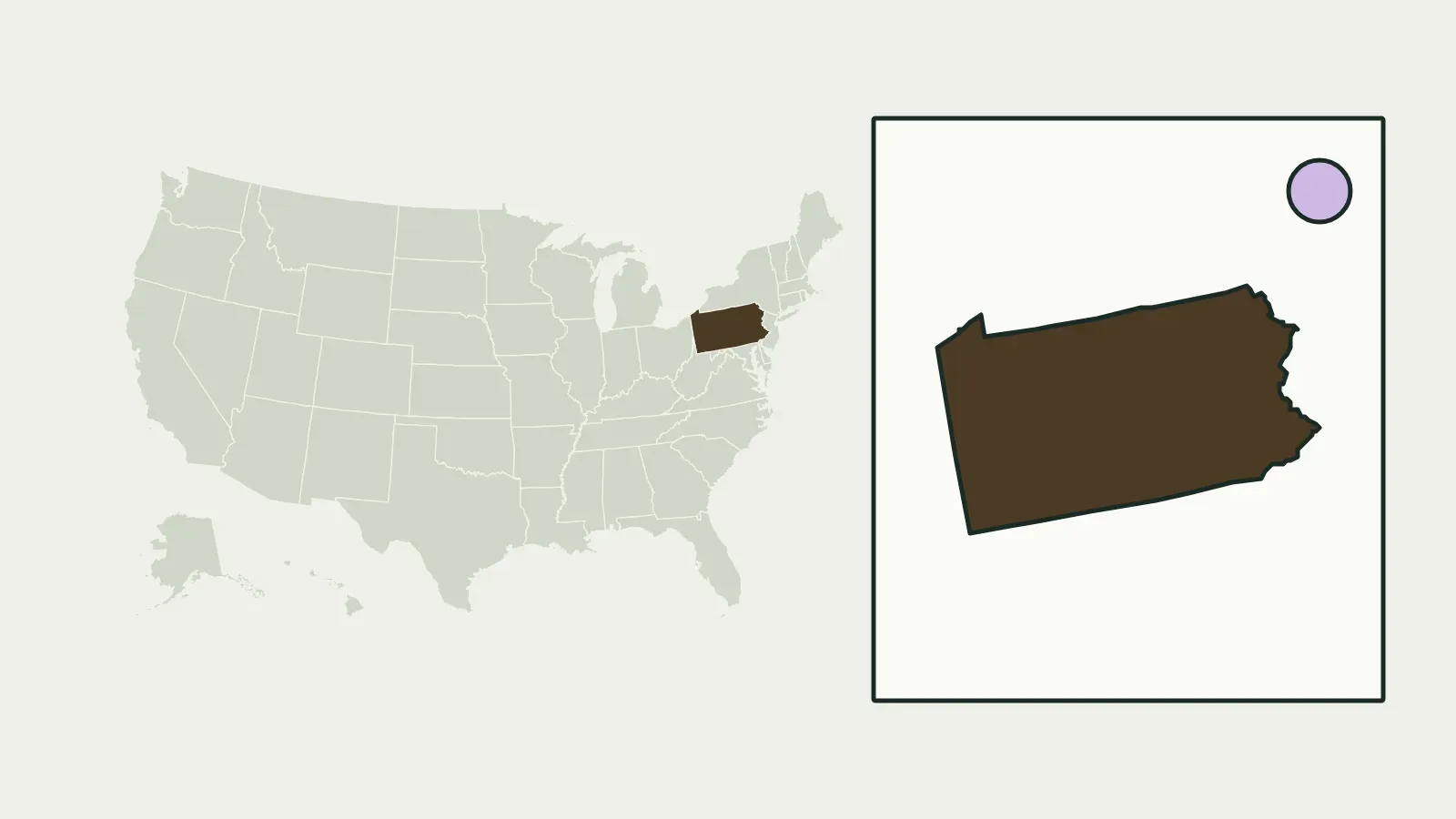
Pennsylvania at a glance
How the Pennsylvania limit works
Pennsylvania does not license personal-loan companies under a general small-loan law. A business corporation that makes or negotiates non-mortgage loans to consumers holds a license under the Consumer Discount Company Act (CDCA), and the act's own schedule of charges limits what it may collect. DoBS applies the act through its regulations in Chapter 41 of the Pennsylvania Code.
The act's charges are not written as one APR, so the figure on your Truth in Lending disclosure is the number to compare. The federal APR counts interest and the fees that are finance charges, which is how the comparison below is built.
Here is how to use that number. A $10,000 loan at 14% for 36 months, with a 5% fee taken from the loan, deposits $9,500 and costs $341.78 a month. Its APR is 17.65%, well under the ceiling for a loan that size. The figures are an example, not an offer.
Who needs a license and who does not
Consumer discount companies apply through the DoBS licensing portal rather than through NMLS, and DoBS lists them in its public institution search. DoBS has also issued an interpretive letter on internet and out-of-state lending under the act, so an online lender that is not a bank should be able to show you a Pennsylvania license.
- Banks and credit unions answer to their own charters and banking regulators, and a bank may charge the rates its home state allows.
- Online lenders that partner with a bank may make loans through that bank, which can put the loan outside the CDCA limits. Ask who the lender of record is.
- Payday and auto title loans are a separate topic. Our sister site Lendmira covers them on its Pennsylvania lending laws page.
How Pennsylvania compares with its neighbors
On the National Consumer Law Center's comparison of a $2,000 two-year loan, Pennsylvania's limit of about 24% APR is at or below every neighbor. New York caps that loan at about 25%, New Jersey and Maryland at about 30%, Ohio at about 31% and West Virginia at about 33%; Delaware sets no cap. Your state of residence and the lender's license decide which rules apply. The state rules map shows every state side by side.
What to check before you sign
- The APR and total of payments on the federal disclosure. On a licensed loan, an APR far above the figures on this page is a reason to ask how the lender is licensed.
- Add-on products such as credit insurance. Ask for the price with and without them; credit insurance and add-ons explains how they change the cost.
- Upfront fees. A demand for a fee before the loan is approved or funded is a warning sign, whatever the state.
Check a lender and file a complaint
- Look up the license in the PA Financial Institutions Search on the DoBS portal before you apply; consumer discount companies are listed there.
- Keep the loan papers: the Truth in Lending disclosure, the agreement and any messages about fees.
- Complain to DoBS through the DoBS Portal, which its Consumer Help Center page links, or call 1-800-PA-BANKS (722-2657).
- Send a complaint to the CFPB as well if the lender is a bank or a bank partner. How to verify a lender lists what to check.
Sources
- Consumer Discount Company Act, Act of April 8, 1937, No. 66 (Pennsylvania General Assembly)
- Non-bank licensees: consumer discount companies (Pennsylvania Department of Banking and Securities)
- Consumer Help Center and complaints (Pennsylvania Department of Banking and Securities)
- State APR caps for $500, $2,000 and $10,000 installment loans, December 2025 (National Consumer Law Center)
We checked the facts on this page against these sources on October 27, 2026. The legislature's statute site did not load for us, so the cap figures rest on the National Consumer Law Center's calculation.
Questions people ask
What is the maximum interest rate on a personal loan in Pennsylvania?
It depends on the lender. A consumer discount company licensed under the CDCA is held to that act's charges, which the National Consumer Law Center puts at about 24% APR on a $2,000 two-year loan and about 26% on a $10,000 five-year loan, fees included. Banks and credit unions follow their own rules.
What is a consumer discount company?
It is the Pennsylvania name for a licensed finance company: a business corporation that makes or negotiates non-mortgage consumer loans under a license from the Department of Banking and Securities.
Do the Pennsylvania limits apply to banks?
No. Banks and credit unions follow their own charters and federal law, and a bank can charge the rate its home state allows. The CDCA binds licensed consumer discount companies.
How do I know if a Pennsylvania lender is licensed?
Search the company in the PA Financial Institutions Search on the DoBS portal. If it is not listed and is not a bank or credit union, ask under what authority it lends before you apply. See how to verify a lender.
Ask lenders for real offers
Describe the loan you have in mind. LendCedar passes your request to lenders and loan brokers who may contact you with offers; you compare them and decide.
- The loan you have in mind: amount, purpose, credit and income.
- Your contact details and your consent to be contacted.
- A lender or loan broker may contact you with an offer. Nothing is decided until you sign with a lender.
LendCedar is not a lender or a loan broker and does not make credit decisions.
You pay LendCedar nothing. Lenders and loan brokers pay us for requests, and they set their own rates and terms. How we make money.
Nearby in the guide
-
Offer term
Total cost of a loan
Finance charge, APR and total of payments, with three worked offers for the same $10,000 loan.
-
Step
Verify a lender
Find the license on NMLS or with your state, match the lender of record and spot advance-fee scams.
-
Offer term
Credit insurance and add-ons
Credit life, disability and job-loss coverage: when it is optional, what it adds, how to cancel it.