Personal Loans in Oklahoma: What Licensed Lenders May Charge
Oklahoma does not set one fixed number. Its Consumer Credit Code lets a supervised lender add a fixed margin to the federal funds rate, plus a closing fee. Here is how the formula works, who needs a license and where to check a lender.
Cap above 36%, by LendCedar Editorial Team Updated 6 minute read
In short
In Oklahoma, a consumer loan priced above 10% a year is a supervised loan, and the lender needs a supervised lender license from the Department of Consumer Credit under the Uniform Consumer Credit Code (Title 14A). Section 3-508A caps the rate at 32% plus the federal funds rate on the first $7,000 of principal, with lower margins above that, and allows a closing fee of up to $196.18 for loans made from July 1, 2026. All in, that allows about 56% APR on a $2,000 two-year loan and about 36% on a $10,000 five-year loan.
- $2,000 loan cap
- 56% APR
- $10,000 loan cap
- 36% APR
- Top rate formula
- 32% + federal funds rate
- Licensed by
- Dept. of Consumer Credit
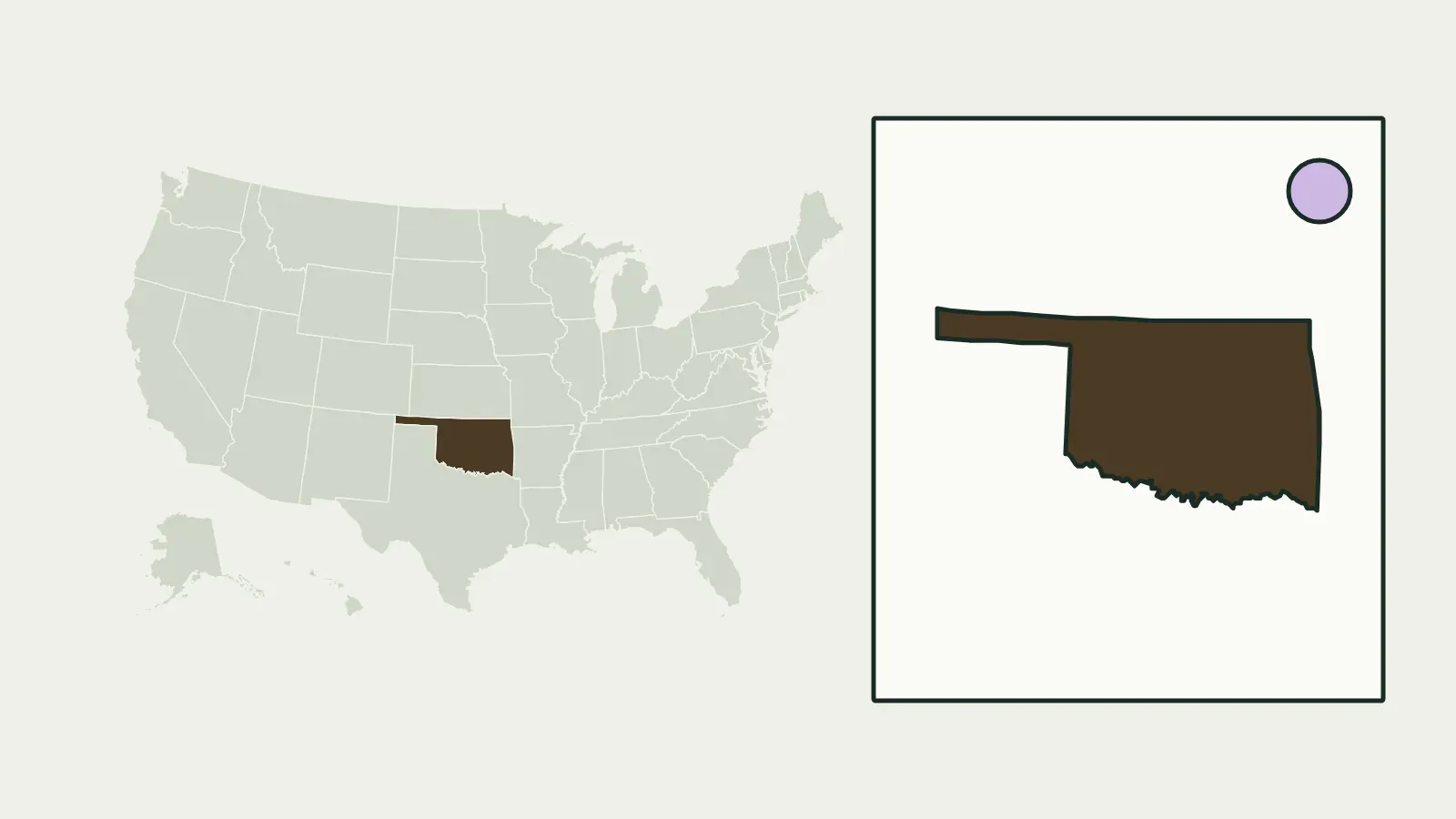
Oklahoma at a glance
How the Oklahoma rate formula works
Section 3-508A of Title 14A sets the ceiling for supervised loans. The finance charge, figured by the actuarial method, may not exceed the greater of two formulas. Both float: each adds a fixed margin to the federal funds rate the Federal Reserve publishes in its H.15 release, as it stood on the first day of the month before the loan is made. When the Federal Reserve moves rates, the Oklahoma ceiling moves with it.
| Formula | Part of the principal | Maximum yearly rate |
|---|---|---|
| Tiered | Up to $7,000 | 32% plus the federal funds rate |
| Tiered | $7,000.01 to $11,000 | 23% plus the federal funds rate |
| Tiered | Above $11,000 | 20% plus the federal funds rate |
| Single rate | Whole unpaid balance | 25% plus the federal funds rate |
On top of the finance charge, the lender may collect a closing fee when the loan is made. The Department of Consumer Credit adjusts the code's dollar amounts every July 1 with consumer prices; for loans made from July 1, 2026 the closing fee limit is $196.18, up from $190.41. On a $2,000 loan that fee alone is almost a tenth of the amount you borrow, which is why the APR on your Truth in Lending disclosure can sit far above the contract rate on a small loan.
The small-loan option in Section 3-508B
For smaller loans, a supervised lender may use Section 3-508B instead of the 3-508A rates. It replaces interest with two charges: an acquisition charge of up to 10% of the principal, earned when the loan is made, and a monthly installment account handling charge that rises with the loan size. The statute sets the top of this option at $3,000; with the yearly price adjustment, it reaches $3,750 for loans made from July 1, 2026. No insurance or other charges are allowed on these loans.
If you repay, refinance or consolidate such a loan within the first 60 days, the lender must refund part of the acquisition charge for each day left until day 60. The section was last amended in 2022, with the change in force since November 1, 2022. A monthly fee adds up fast on a small balance, so compare the total of payments with a credit union loan before you sign.
Who needs a license and who does not
A business that makes or buys supervised loans needs a supervised lender license from the Oklahoma Department of Consumer Credit. The license is renewed every year and requires a surety bond and minimum net assets. Online lenders that lend to Oklahomans under state law are licensed the same way.
- Banks and credit unions answer to their own charters and banking regulators instead, and a bank may charge the rates its home state allows.
- Online lenders that partner with a bank may make loans through that bank, which can put the loan outside the Oklahoma formula. Ask who the lender of record is.
- High-cost small loans under the Oklahoma Small Lenders Act are a separate license with their own rules. Our sister site Lendmira covers them on its Oklahoma lending laws page.
How Oklahoma compares with its neighbors
On the National Consumer Law Center's comparison of a $2,000 two-year loan, Oklahoma allows more than any neighbor that sets a cap. Arkansas caps that loan at about 17% APR, Colorado at 31%, New Mexico at 36%, Texas at about 37% and Kansas at about 38%; Missouri sets no cap. Your state of residence and the lender's license decide which rules apply. The state rules map shows every state side by side.
Check a lender and file a complaint
- Look up the license in the license rosters of the Department of Consumer Credit at oklahoma.gov/okdocc before you apply.
- Keep the loan papers: the Truth in Lending disclosure, the agreement and any messages about fees.
- Complain to the Department of Consumer Credit with its online complaint form, or call (405) 521-3653, if a licensed lender breaks the rules.
- Send a complaint to the CFPB as well if the lender is a bank or a bank partner, or if you are unsure who regulates it. How to verify a lender lists what to check.
Sources
- Oklahoma Statutes, title 14A, section 3-508A — Loan finance charge for supervised loans (Justia, 2025 edition)
- Oklahoma Statutes, title 14A, section 3-508B — Loans with principal of $3,000 or less (Justia, 2025 edition)
- Changes in dollar amounts, July 1, 2026 (Oklahoma Department of Consumer Credit)
- Supervised lender license (Oklahoma Department of Consumer Credit)
- Submit a complaint (Oklahoma Department of Consumer Credit)
- State APR caps for $500, $2,000 and $10,000 installment loans, December 2025 (National Consumer Law Center)
We checked the facts on this page against these sources on October 27, 2026. The dollar amounts change every July 1, and the rate ceiling moves whenever the federal funds rate does.
Questions people ask
What is the maximum interest rate on a personal loan in Oklahoma?
For a supervised lender using Section 3-508A, it is the greater of a tiered rate (32% plus the federal funds rate on the first $7,000, 23% plus that rate up to $11,000 and 20% plus that rate above) or 25% plus the federal funds rate on the whole balance, plus a closing fee of up to $196.18 for loans made from July 1, 2026.
Why does the Oklahoma limit change?
The margins are fixed, but the federal funds rate they are added to moves with Federal Reserve policy. The dollar amounts, such as the closing fee and the tier break points, are adjusted each July 1 with consumer prices.
Do the Oklahoma limits apply to banks?
No. Banks and credit unions follow their own charters and federal law, and a bank can charge the rate its home state allows. The Section 3-508A limits bind supervised lenders licensed under Title 14A.
How do I know if an Oklahoma lender is licensed?
Check the license rosters of the Oklahoma Department of Consumer Credit. If the company is not listed and is not a bank, ask under what authority it lends to Oklahomans before you apply. See how to verify a lender.
Ask lenders for real offers
Describe the loan you have in mind. LendCedar passes your request to lenders and loan brokers who may contact you with offers; you compare them and decide.
- The loan you have in mind: amount, purpose, credit and income.
- Your contact details and your consent to be contacted.
- A lender or loan broker may contact you with an offer. Nothing is decided until you sign with a lender.
LendCedar is not a lender or a loan broker and does not make credit decisions.
You pay LendCedar nothing. Lenders and loan brokers pay us for requests, and they set their own rates and terms. How we make money.
Nearby in the guide
-
Offer term
Total cost of a loan
Finance charge, APR and total of payments, with three worked offers for the same $10,000 loan.
-
Step
Verify a lender
Find the license on NMLS or with your state, match the lender of record and spot advance-fee scams.
-
Offer term
Truth in Lending disclosures
The federal box line by line: APR, finance charge, amount financed, total of payments and what sits below.