Personal Loans in North Carolina: What Licensed Lenders May Charge
North Carolina caps consumer finance loans with rate tiers that fall as the balance grows. A 2023 law raised the top loan size to $25,000 and reset the tiers. Here is how they work, who needs a license, and where to complain.
Cap 36% or less, by LendCedar Editorial Team Updated 7 minute read
In short
A business that lends $25,000 or less in North Carolina at more than the general usury law allows needs a license from the Commissioner of Banks under the Consumer Finance Act (G.S. Chapter 53, Article 15). On loans of up to $12,000, G.S. 53-176 allows simple interest of 33% on the first $4,000, 24% on the next $4,000 and 18% on the rest; larger loans carry 18%. A processing fee of up to $150 may be added. On the National Consumer Law Center's comparison, that allows about 35% APR on a $2,000 two-year loan and about 29% on a $10,000 five-year loan.
- $2,000 loan cap
- 35% APR
- $10,000 loan cap
- 29% APR
- Rate tiers
- 33% / 24% / 18%
- Licensed by
- NC Commissioner of Banks
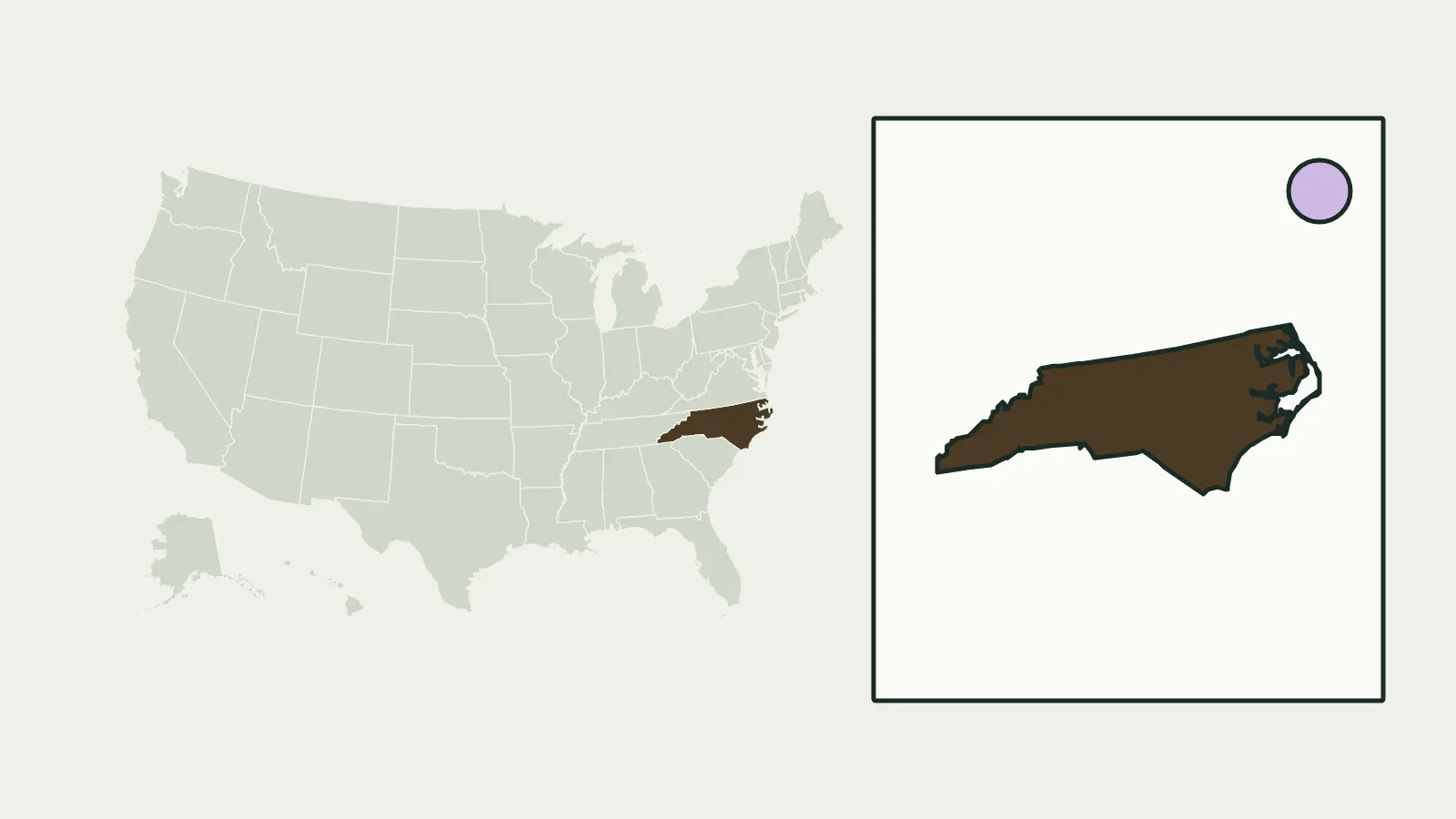
North Carolina at a glance
How the North Carolina rate tiers work
G.S. 53-176 covers installment loans of up to $25,000, repaid in substantially equal monthly payments over 12 to 96 months and not secured by real estate. Interest is simple interest on the unpaid principal, and each slice of the balance carries its own maximum rate. As you pay the loan down, more of the balance falls into the higher-rate first slice, so the blended rate on a mid-size loan is lower than 33% but not as low as 18%.
| Loan size at origination | Part of the unpaid principal | Maximum yearly rate |
|---|---|---|
| Up to $12,000 | First $4,000 | 33% |
| Up to $12,000 | $4,000 to $8,000 | 24% |
| Up to $12,000 | Above $8,000 | 18% |
| Over $12,000, up to $25,000 | All of it | 18% |
The lender may also charge a processing fee at closing: up to $30 on a loan of $3,000 or less, and up to 1% of the amount financed, with a $150 maximum, on larger loans. It may charge that fee no more than twice in any 12 months. Because the fee is a finance charge, the APR on your Truth in Lending disclosure will be a little higher than the tier rates.
What changed in 2023
Session Law 2023-61 (Senate Bill 331) amended the Consumer Finance Act. The General Assembly ratified it on June 8, 2023, and it became law over the governor's veto on June 27, 2023. It applies to loans entered into, modified or renewed on or after October 1, 2023.
- Larger loans: the act now covers loans of up to $25,000, up from $15,000.
- New tiers: the first-tier rate rose from 30% to 33%, and the three-tier structure now reaches loans of up to $12,000 instead of $10,000.
- Higher fees: the processing fee cap rose from $40 to $150 on larger loans and from $25 to $30 on small ones, and the late fee cap rose from $15 to $18.
Loans made before October 1, 2023 keep their original terms unless they are modified or renewed. See rule changes for other dated changes we track.
How North Carolina compares with its neighbors
On the National Consumer Law Center's comparison of a $2,000 two-year loan, North Carolina's 35% is above Georgia at about 32% and well below Tennessee at about 49% and Virginia at about 50%. South Carolina sets no numeric cap. The rules that apply follow the lender's license and your state of residence. The state rules map shows every state side by side.
Who needs a license and who does not
Under G.S. 53-166, anyone in the business of lending or servicing loans of $25,000 or less who charges more than Chapter 24 permits, counting interest, fees and expenses together, must first get a license from the Commissioner of Banks. The rule reaches anyone who tries to avoid it by any device, subterfuge or pretense. A loan made in violation is void: the lender may not collect principal or charges, except for an accidental or good-faith computation error.
- Banks and credit unions answer to their own charters and banking regulators instead, and a bank may charge the rates its home state allows.
- Online lenders that partner with a bank may make loans through that bank, which can put the loan outside the Consumer Finance Act tiers. Ask who the lender of record is.
- Payday and title loans are covered on our sister site Lendmira's North Carolina lending laws page.
Check a lender and file a complaint
- Check the license before you apply: the Commissioner of Banks' Who We Regulate page explains which lenders it licenses, and the lender should give you its license number.
- Keep the loan papers: the Truth in Lending disclosure, the agreement and any messages about fees.
- Complain to the Office of the Commissioner of Banks online at https://nccob.nc.gov/consumer-information/consumer-inquiries-and-complaint-information or by phone at 919-733-3016.
- Send a complaint to the CFPB as well if the lender is a bank or a bank partner. Our guide on how to verify a lender lists the warning signs.
Sources
- G.S. 53-176 — Alternative rates and terms for consumer finance loans (North Carolina General Assembly)
- G.S. 53-166 — License required, evasion and penalties (North Carolina General Assembly)
- Session Law 2023-61 (Senate Bill 331), an act to amend the North Carolina Consumer Finance Act
- N.C. Office of the Commissioner of Banks — consumer information and complaints
- State APR caps for $500, $2,000 and $10,000 installment loans, December 2025 (National Consumer Law Center)
We checked the facts on this page against these sources on October 27, 2026. The tiers shown apply to loans made, modified or renewed on or after October 1, 2023.
Questions people ask
What is the maximum interest rate on a personal loan in North Carolina?
For a licensed consumer finance loan of up to $12,000, it is 33% a year on the first $4,000 of unpaid principal, 24% on the next $4,000 and 18% on the rest. Loans over $12,000, up to $25,000, carry 18%. A processing fee of up to $150 may be added.
When did the current North Carolina rates start?
On October 1, 2023, under Session Law 2023-61. They apply to loans entered into, modified or renewed on or after that date.
Do the North Carolina caps apply to banks?
No. Banks and credit unions follow their own charters and federal law, and a bank can charge the rate allowed in its home state. The tiers bind lenders licensed under the Consumer Finance Act.
What is the late fee limit on a North Carolina consumer finance loan?
Session Law 2023-61 raised the maximum late fee to $18. Read late fees and returned payments for how to find this charge in your agreement.
Ask lenders for real offers
Describe the loan you have in mind. LendCedar passes your request to lenders and loan brokers who may contact you with offers; you compare them and decide.
- The loan you have in mind: amount, purpose, credit and income.
- Your contact details and your consent to be contacted.
- A lender or loan broker may contact you with an offer. Nothing is decided until you sign with a lender.
LendCedar is not a lender or a loan broker and does not make credit decisions.
You pay LendCedar nothing. Lenders and loan brokers pay us for requests, and they set their own rates and terms. How we make money.
Nearby in the guide
-
Offer term
Total cost of a loan
Finance charge, APR and total of payments, with three worked offers for the same $10,000 loan.
-
Step
Verify a lender
Find the license on NMLS or with your state, match the lender of record and spot advance-fee scams.
-
Offer term
Late fees and returned payments
Where the late charge appears, why the APR leaves it out, state limits in Ohio and Florida, and federal rules.