Personal Loans in New Mexico: What Licensed Lenders May Charge
Since January 1, 2023, New Mexico has capped licensed loans of $10,000 or less at 36% APR, counted with fees, add-ons and credit insurance. Here is how the cap works, who needs a license, and where to check a lender.
Cap 36% or less, by LendCedar Editorial Team Updated 6 minute read
In short
A business that lends $10,000 or less in New Mexico needs a license under the Small Loan Act of 1955, or must lend under the Bank Installment Loan Act of 1959. Since January 1, 2023, the APR on a small loan may not exceed 36%, and that APR counts fees, add-on products and credit insurance even where federal rules would leave them out (NMSA 58-15-17). The change came from House Bill 132, signed in 2022, which lowered the cap from 175%. The Financial Institutions Division of the Regulation and Licensing Department licenses lenders and takes complaints.
- $2,000 loan cap
- 36% APR
- $10,000 loan cap
- 36% APR
- Cap in force since
- January 1, 2023
- Licensed by
- RLD Financial Institutions
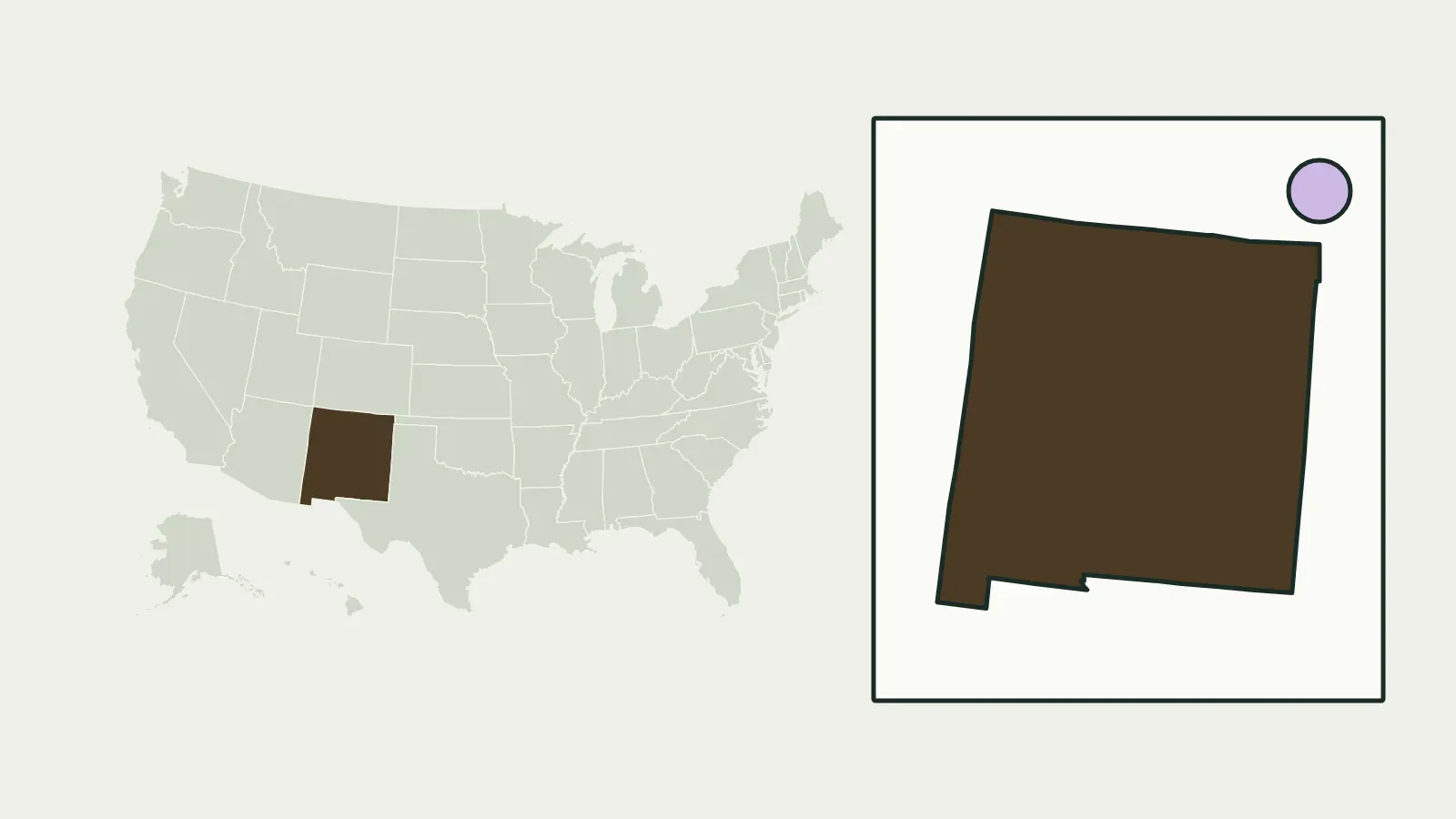
New Mexico at a glance
How the New Mexico cap works
New Mexico uses one flat cap rather than tiers. Section 58-15-17(J) sets the permitted annual percentage rate at 36%, calculated under Regulation Z. Unlike the federal disclosure rules, the state's calculation must include charges for ancillary products and services, fees tied to the credit and credit insurance premiums. Only amounts paid to public officials, such as lien-recording fees, stay out.
| Charge | Counted in the 36%? |
|---|---|
| Interest and finance charges | Yes |
| Ancillary products and services, credit-related fees | Yes |
| Credit insurance premiums | Yes |
| Fees paid to public officials, such as lien recording | No |
There is one exception for very small loans: on a loan of $500 or less, a fee of up to 5% of the principal, charged no more than once in 12 months, is left out of the APR. The statute also lets the cap rise by one percentage point for each point the prime rate stays above 10% for three consecutive months, and fall back to 36% when it drops below 10% again.
What changed in 2023
House Bill 132, titled "Interest Rates for Certain Loans," was signed by the governor on March 1, 2022 as Chapter 23 of the Laws of 2022. Its amendment to Section 58-15-17 took effect on January 1, 2023 and lowered the small-loan cap from 175% to 36%. Loans made before that date followed the old rules; any loan you take from a licensed lender now falls under the 36% limit. See rule changes for other dated changes we track.
How New Mexico compares with its neighbors
On the National Consumer Law Center's comparison of a $2,000 two-year loan, New Mexico's 36% is lower than Texas at about 37%, Arizona at about 41% and Oklahoma at about 56%, and higher than Colorado at about 31%. Utah sets no numeric cap. The rules that apply follow the lender's license and your state of residence. The state rules map shows every state side by side.
Who needs a license and who does not
Anyone in the business of lending $10,000 or less in New Mexico must first get a license from the director, and such loans must be made under the Small Loan Act or the Bank Installment Loan Act (NMSA 58-15-3). Arranging loans above the state's limits online or by phone is covered even if the business has no office in the state.
- Banks, savings and loan associations and credit unions chartered by a state or the federal government are exempt from licensing.
- Bank partners can still need a license. Section 58-15-3(D) reaches an agent or service provider for an exempt entity when the loan exceeds the permitted rate and that company holds the predominant economic interest, markets or buys the loans, or is in substance the lender. Loans made in violation are void.
- Payday and title loans of $10,000 or less fall under the same Small Loan Act and its cap. Our sister site Lendmira describes them on its New Mexico lending laws page.
Check a lender and file a complaint
- Verify the license with the Regulation and Licensing Department's Verify a License search at https://www.rld.nm.gov/about-us/public-information-hub/verify-a-license/ before you apply.
- Keep the loan papers: the Truth in Lending disclosure, the agreement and a list of every add-on product you were offered.
- File a complaint with the department at https://www.rld.nm.gov/help-center/file-a-complaint/ if a lender charges more than 36% or will not tell you who the lender is.
- Send a complaint to the CFPB as well if the lender is a bank or a bank partner. Our guide on how to verify a lender lists the warning signs.
Sources
- NMSA 58-15-17 — Small Loan Act, interest and charges (Justia, 2025 New Mexico Statutes)
- NMSA 58-15-3 — Small Loan Act, license required, exemptions and evasion (Justia, 2025 New Mexico Statutes)
- House Bill 132 (2022), Interest Rates for Certain Loans, Chapter 23 (New Mexico Legislature)
- Financial Institutions Division, New Mexico Regulation and Licensing Department
- State APR caps for $500, $2,000 and $10,000 installment loans, December 2025 (National Consumer Law Center)
We checked the facts on this page against these sources on October 27, 2026. The 36% cap was set by Chapter 23 of the Laws of 2022 and took effect on January 1, 2023.
Questions people ask
What is the maximum interest rate on a personal loan in New Mexico?
For a licensed loan of $10,000 or less, the APR may not exceed 36%, and that figure includes fees, add-on products and credit insurance. The cap has applied since January 1, 2023.
Is there any fee allowed on top of the 36%?
Only on loans of $500 or less: a fee of up to 5% of the principal, once in 12 months, is not counted in the APR. Fees paid to public officials, such as lien recording, are also outside it.
Do the New Mexico caps apply to banks and credit unions?
Banks, savings and loan associations and credit unions are exempt from small loan licensing. A non-bank that markets or holds a bank's loans above the cap can still be treated as the lender under NMSA 58-15-3(D).
Who regulates personal loan lenders in New Mexico?
The Financial Institutions Division of the New Mexico Regulation and Licensing Department. See how to verify a lender for what to check before you apply.
Ask lenders for real offers
Describe the loan you have in mind. LendCedar passes your request to lenders and loan brokers who may contact you with offers; you compare them and decide.
- The loan you have in mind: amount, purpose, credit and income.
- Your contact details and your consent to be contacted.
- A lender or loan broker may contact you with an offer. Nothing is decided until you sign with a lender.
LendCedar is not a lender or a loan broker and does not make credit decisions.
You pay LendCedar nothing. Lenders and loan brokers pay us for requests, and they set their own rates and terms. How we make money.
Nearby in the guide
-
Offer term
Credit insurance and add-ons
Credit life, disability and job-loss coverage: when it is optional, what it adds, how to cancel it.
-
Step
Verify a lender
Find the license on NMLS or with your state, match the lender of record and spot advance-fee scams.
-
Offer term
Total cost of a loan
Finance charge, APR and total of payments, with three worked offers for the same $10,000 loan.